The material
What is limewash?
Limewash is slaked lime and mineral pigment suspended in water. Brushed onto a porous surface it does not dry into a film on top — it soaks in, reacts with the air, and turns back into stone inside the wall.
That single difference explains everything else about it: why it is breathable, why it has no VOCs to off-gas, why it gets harder for years while paint gets weaker, and why a limewashed wall moves with the light in a way a painted one never does.
How it actually works
Limestone is burned to make quicklime, then slaked with water to make calcium hydroxide — lime putty. Thinned down and tinted with mineral pigment, that is limewash.
Once it is on the wall, the calcium hydroxide reacts with carbon dioxide in the air and converts to calcium carbonate. Which is limestone again. The finish on your wall is chemically the same material it was quarried as, reformed in place.
That process does not finish in a weekend. It continues for years, which is why lime finishes get harder with age instead of chalking and peeling. A latex paint is at its strongest the day it cures and declines from there.
- Breathable Moisture in a wall passes out through the finish rather than being trapped behind a plastic film. On solid masonry that is not a preference, it is what keeps the wall sound.
- Zero VOC High-calcium lime, mineral pigment, water. No synthetic binders, no solvents, nothing to off-gas as it cures.
- Naturally alkaline Fresh lime sits around pH 12, which is inhospitable to mould and mildew without adding a biocide.
- Ages forward It carbonates and hardens for years. Exteriors weather softly instead of peeling.
Why it looks the way it does
Paint is pigment suspended in plastic. It absorbs light at a uniform value, which is why a painted wall reads as one flat colour from every angle at every hour.
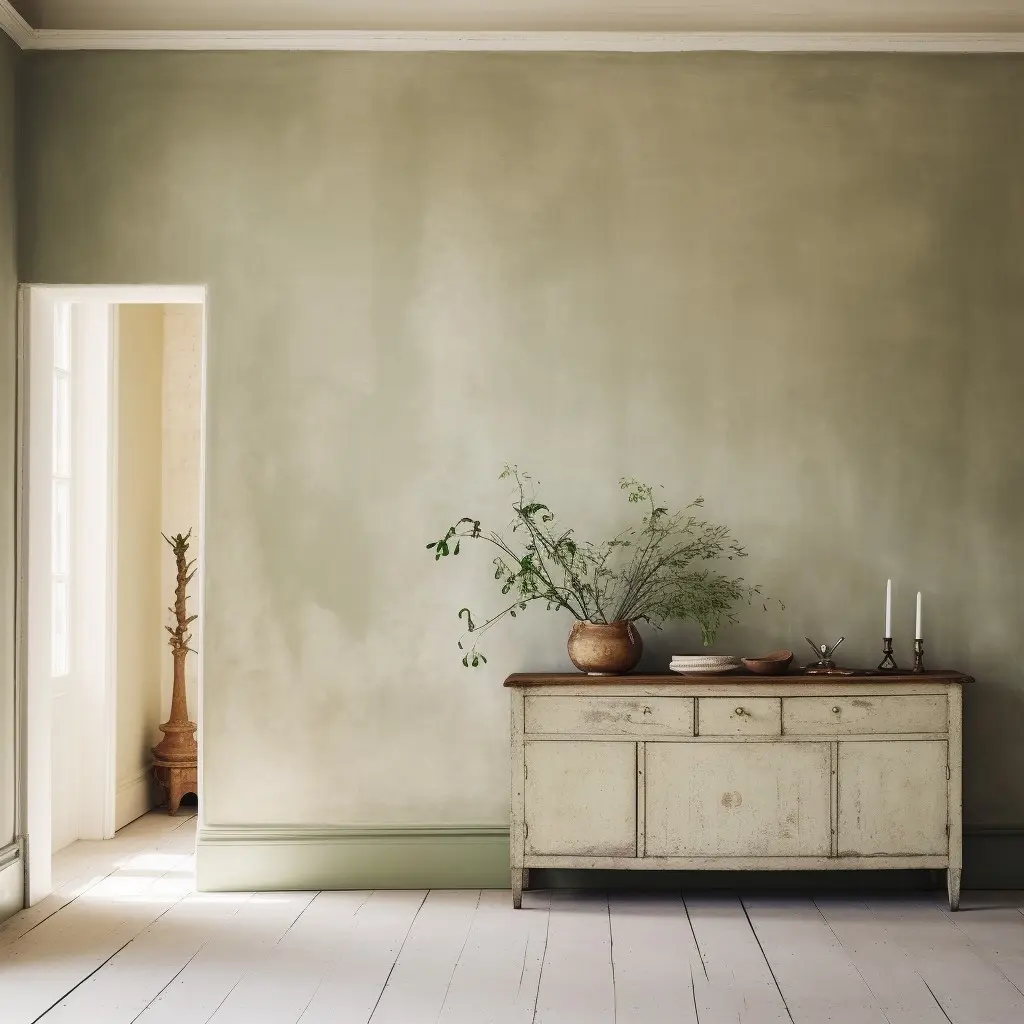
Lime is crystalline. It refracts light rather than absorbing it evenly, so the surface changes with the angle and colour temperature of whatever is hitting it. The same wall reads cool and quiet at midday and warm with real depth at low sun.
That is the quality people are actually buying, and it is the one thing a photograph can never quite carry.

Where it belongs — and where it does not
It is at its best on anything porous. Brick, stone, lime render, raw or new plaster, and masonry generally. On those it bonds beautifully with no preparation beyond cleaning.
On drywall it needs preparation. Lime keys into pores and cured paint has none, so painted drywall needs a mineral primer or a thin skim coat first. Skip that and the lime never bonds — it dusts and wipes off, which is the most common reason a DIY limewash job fails. The drywall guide covers it properly.
It is not for standing water. Bathrooms and kitchens are fine — breathability is an advantage in a damp room. A shower surround is not: that wants tadelakt, a polished lime plaster sealed with olive soap that is genuinely waterproof.
The one we make
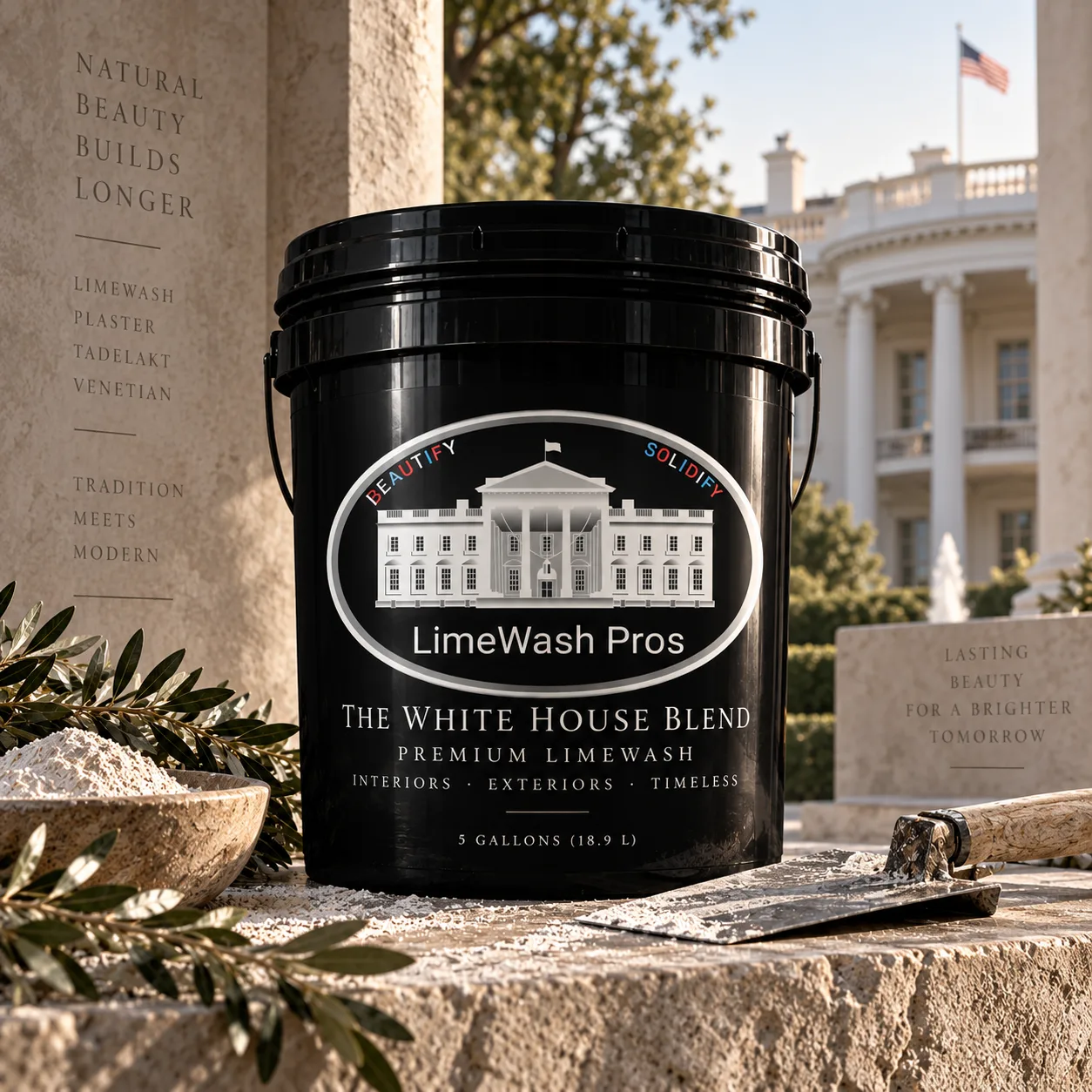
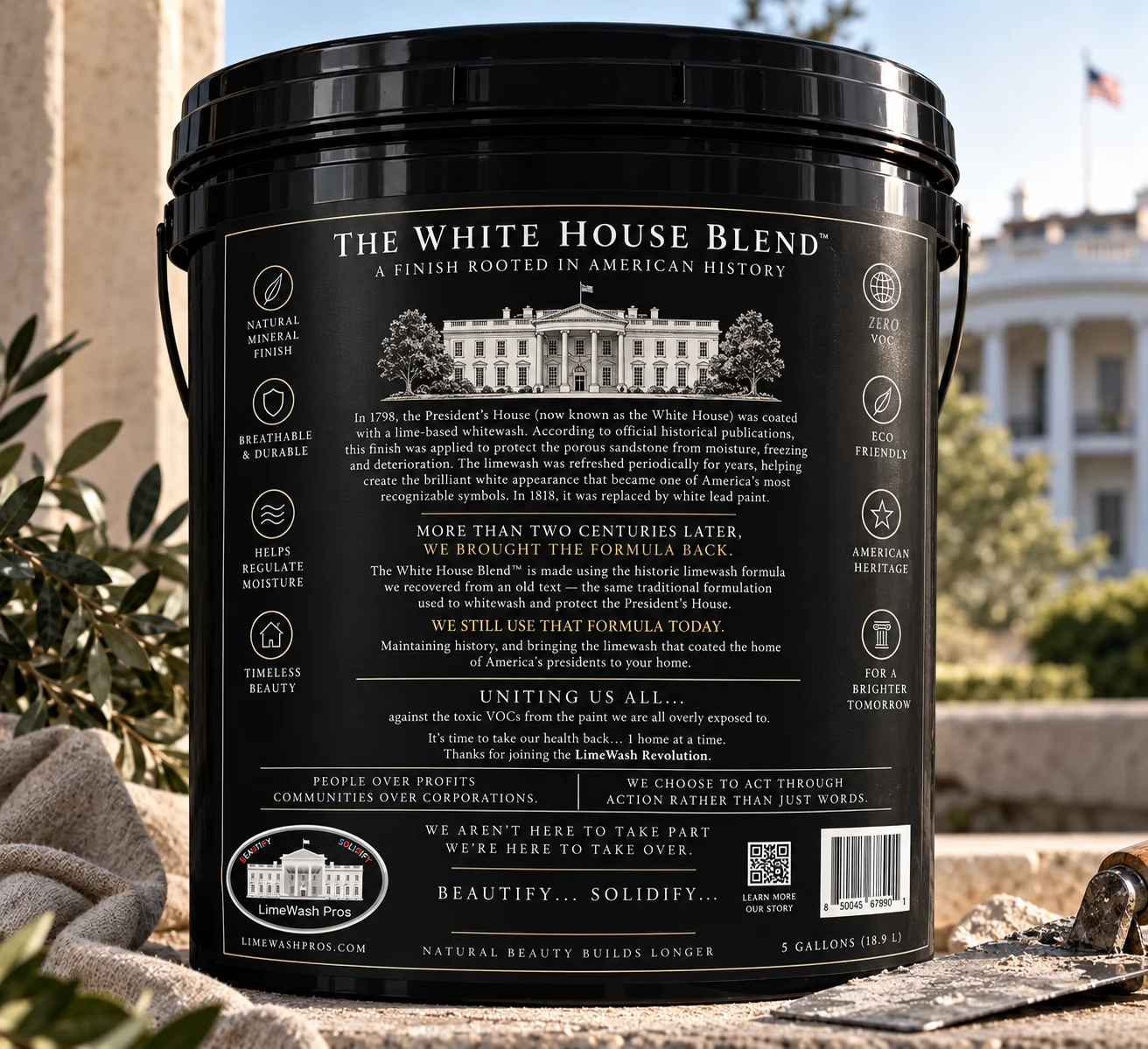
The White House Blend™ is made by hand in house from high-calcium lime, mineral pigment and purified aggregates — to the lime whitewash recipe recorded for the President’s House in 1798.
It is tinted by hand, to your colour, rather than picked off a manufacturer’s deck. From a photograph, a fabric swatch, a stone sample, or a wall you already have and want to match.
We are a lime finishing company before we are a paint company. We apply this material on client walls most weeks — which is why every order includes the full application course rather than a data sheet.
Or have it done
If the room matters and you would rather not learn on it, that is what we do. LimeWash Pros applies limewash, Venetian plaster, Marmorino and Tadelakt by hand across Dallas, Fort Worth and the wider Metroplex, in Austin, and in Palm Beach.
Every project is sampled personally by Ben Lynch, certified by the San Marco Academy in Venice.
Questions worth asking
How long does limewash last?
Decades on masonry, and it improves rather than degrades. Lime continues to carbonate — it keeps absorbing carbon dioxide and hardening for years after it goes on. That is the opposite of a paint film, which begins failing the day it cures. Interiors realistically outlive the decor around them. Exteriors weather gradually and softly rather than peeling, which is why you can find limewashed buildings in Europe still holding a finish applied generations ago.
Does limewash rub off on clothes?
Properly applied and cured, no. Chalking happens when limewash is put over a non-porous surface with no key — painted drywall with no mineral primer is the usual culprit — so the lime never bonds and sits as dust. On a correctly prepared substrate it hardens into the surface. If an existing limewashed wall is marking clothes, that is a bonding failure underneath, not the nature of the material.
Can you limewash over painted walls?
Not directly. Lime bonds mechanically, keying into pores, and cured paint is a sealed film with no pores to key into. You need a mineral primer — the kind sold for lime and silicate systems, not a glossy acrylic sealer — or a thin skim coat. This is the single most common reason a DIY limewash job fails.
Is limewash the same as chalk paint or Venetian plaster?
No, and they are frequently confused. Chalk paint is an acrylic paint with a matte additive — it looks flat, but it is still a plastic film. Venetian plaster is a troweled lime plaster applied in multiple layers and burnished to a polish, much thicker and considerably more labour. Limewash is brushed on thin, stays matte and translucent, and lets the wall underneath read through. Different material, different tool, different result.
Why does limewash look different in the morning and the evening?
Because it is a mineral, not a pigment suspended in plastic. Lime crystals refract light rather than absorbing it uniformly, so the surface shifts with the angle and colour temperature of the light hitting it. A wall reads cooler and flatter at midday and warmer with depth at low sun. It is the single most commented-on quality of a limewashed room and it is the thing a photograph never quite captures.
Does limewash work in bathrooms and kitchens?
Yes — lime is breathable and naturally alkaline, which is an advantage in damp rooms, and it has historically been used in dairies and cellars for exactly that reason. The limit is direct water contact. A shower surround wants tadelakt, a polished lime plaster sealed with olive soap that is genuinely waterproof, rather than limewash.
How much does limewash cost?
The White House Blend is $50 a gallon, or $45 a gallon in the five-gallon pail, shipped free anywhere in the United States. For comparison, checked September 2026: Romabio works out to roughly $64 a gallon at Home Depot and Portola is commonly $60 to $80. One gallon covers about 140 square feet at two coats, so a small bedroom is usually two gallons.
The real difference between limewash and paint
It is not the look. It is what you are breathing for the next ten years.
Paint is pigment suspended in a synthetic binder, and that binder has to stay liquid in the tin and then harden on your wall. The chemistry that makes that possible is the chemistry that leaves the wall afterwards — into the room.
“Concentrations of many VOCs are consistently higher indoors (up to ten times higher) than outdoors.”
US Environmental Protection Agency — Volatile Organic Compounds’ Impact on Indoor Air Quality
The EPA names the sources plainly — “paints, varnishes and wax all contain organic solvents”, alongside paint strippers and other solvents. And the spike during the work itself is not a rounding error:
“During and for several hours immediately after certain activities, such as paint stripping, levels may be 1,000 times background outdoor levels.”
EPA — VOCs’ Impact on Indoor Air Quality
What that exposure is associated with, again in the EPA’s own words: “eye, nose and throat irritation; headaches, loss of coordination and nausea; damage to liver, kidney and central nervous system” — and that “some organics can cause cancer in animals, some are suspected or known to cause cancer in humans.”
Read it yourself
We would rather you checked than took our word for it. These are the primary sources, not somebody’s summary of them.
- EPA — Volatile Organic Compounds’ Impact on Indoor Air QualityThe ten-times figure, the source list, the 1,000× spike and the health effects.
- EPA — Technical Overview of Volatile Organic CompoundsHow VOCs are defined and regulated — and why “low-VOC” on a tin is a narrower claim than it sounds.
- Indoor Airborne VOCs from Water-Based Coatings: Transfer Dynamics and Health ImplicationsPeer-reviewed, open access. Water-based does not mean VOC-free, and this is the work that shows why.
- Yearlong study of indoor VOC variabilityPeer-reviewed. How indoor VOC exposure behaves across a whole year, not just on painting day.
Limewash has none of it
High-calcium lime, mineral pigment, purified aggregates, water. No synthetic binder, because lime does not need one — it hardens by reacting with the air, not by a solvent leaving the film.
Nothing in the tin has to evaporate out of your wall, so there is nothing to off-gas. This is not a reformulated low-VOC version of a solvent product. It is a material that never had solvents in it to begin with.
Two ways to get it out of your house
Do a room yourself. The White House Blend™ is $50 a gallon, $225 for the five-gallon pail, shipped free anywhere in the United States and tinted by hand to your colour — with the full application course included and a lifetime warranty on the material for interior work.
Or do the whole house. The Zero VOC Home Program measures the VOC levels in your home, transitions every painted wall and ceiling to zero-VOC limewash, then measures again — so you see the difference rather than take it on faith. From $85 a month.
Who we are
Thirty seconds, then stay for the podcast.
I’m Ben Lynch. I started LimeWash Pros after reading what the EPA had published about the air inside ordinary American houses — and realizing the walls were the problem.

Meet LimeWash Pros
Who we are, what lime does that paint cannot, and why the air inside your house is the reason we do this.
The podcast
 11:33
11:33From Setback to Limewash Success: Meet Ben Lynch
Why I walked away from conventional paint, what I found in the research on VOCs, and how that turned into LimeWash Pros.
 12:10
12:10How Modern Paint is Killing You
The VOCs in ordinary latex paint don’t stop off-gassing when the wall dries. What that does to the air in your house.
 9:43
9:43The Carcinogen On Your Walls
Benzene is a known human carcinogen and it is in the paint on every surface of your home. What the research says.