Choosing a finish
Venetian plaster vs limewash vs tadelakt
All three are lime. All three are zero VOC, breathable, and get harder with age. And they produce three finishes with almost nothing in common.
The difference is not the material. It is how thick it goes on and what happens to the surface afterwards — brushed thin and left matte, troweled in layers and polished, or compressed with a stone and sealed with olive soap.
We apply all three, and we have no reason to steer you. Here is how to pick.
The short version
| Limewash | Venetian plaster | Tadelakt | |
|---|---|---|---|
| What it is | Slaked lime thinned with water | Lime plaster with marble dust | Lime plaster, stone-burnished |
| Applied with | Brush | Steel trowel, several passes | Trowel, then a smooth stone |
| Thickness | Almost none — a stain | A few millimetres | A few millimetres |
| Finish | Matte, chalky, cloudy | Satin to high polish, marbled | Soft seamless sheen |
| Substrate reads through | Yes, that is the point | No | No |
| Durability | Marks easily, touches up invisibly | Hard and wipeable | Hard and waterproof |
| Wet areas | Damp rooms yes, showers no | Bathroom walls yes, showers no | Yes — showers, tubs, sinks |
| Exterior | Yes, excellent | Limited | Limited |
| DIY | Genuinely doable | No | No |
| Relative cost | $ | $$$ | $$$$ |
The row that decides most projects is “substrate reads through”. Limewash is translucent and lets the wall behind it show. The two plasters are opaque and become the wall. Everything else follows from that.
Finish one
Limewash
Slaked lime thinned with water and brushed on in coats thin enough to see through. It soaks into the surface and carbonates there, so the finished wall is not a wall with a coating on it — it is a wall whose surface is now partly lime.
What people respond to is the movement. Because lime refracts light rather than absorbing it uniformly, a limewashed wall reads cooler and flatter at midday and warmer with real depth at low sun. It is the most commented-on quality of a limewashed room and it is the thing a photograph never quite captures.
It is also the only one of the three a homeowner can realistically do themselves, and the only one that goes on brick and exteriors properly.
- Best for
- Whole rooms, ceilings, brick, fireplaces, entire house exteriors
- Not for
- Showers, or anywhere you want flat uniform colour
- Durability
- Marks more easily than plaster — but touches in invisibly
- Cost
- The least of the three by a wide margin
- DIY
- Yes. $50 a gallon, $225 the five-gallon pail, shipped free

Finish two
Venetian plaster
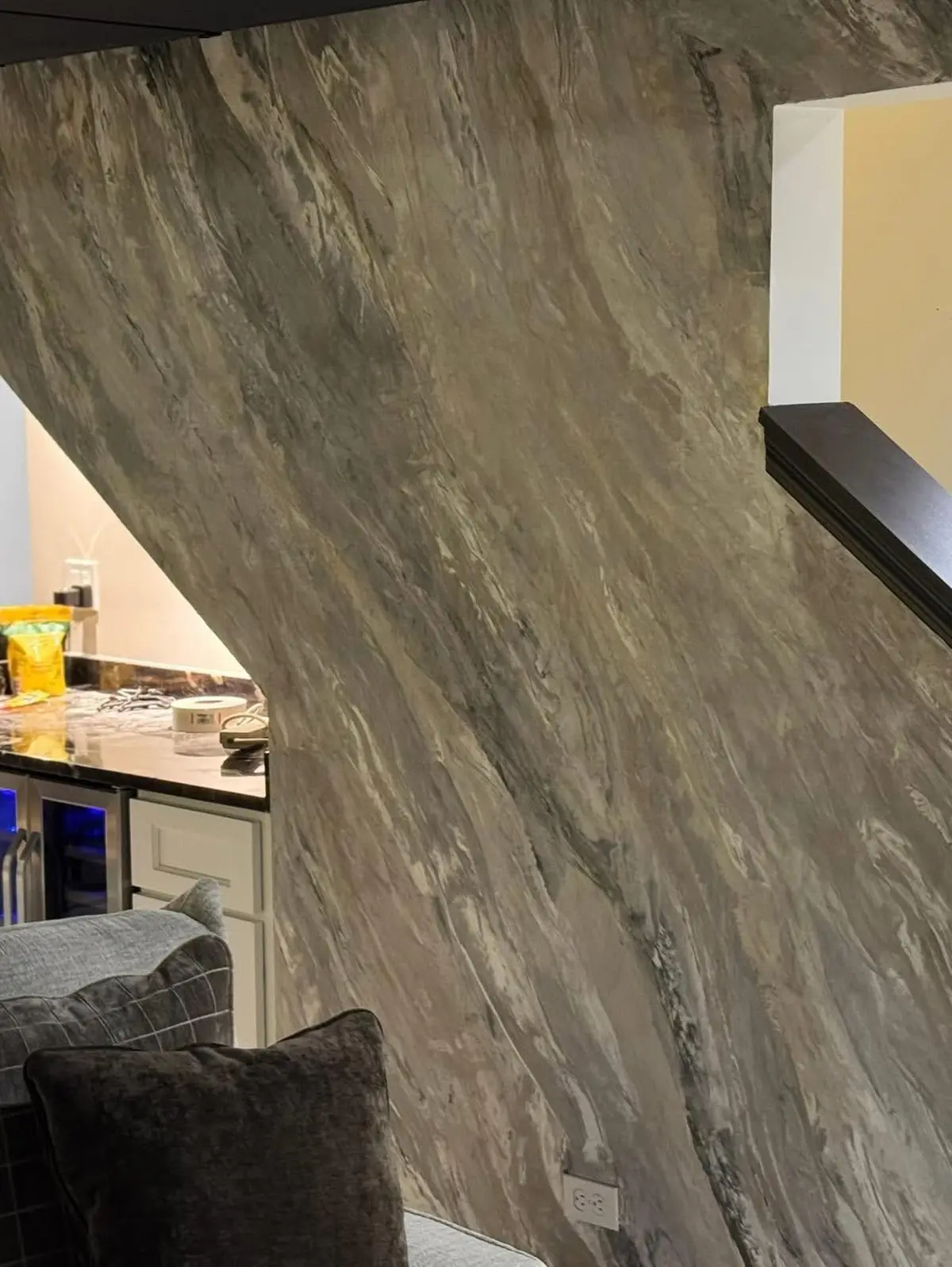
Lime plaster with marble dust in it, troweled on in multiple thin layers and burnished with a steel trowel as it sets. The layering is what creates the depth — you are looking into several translucent passes of stone, not at a colour on a surface.
The sheen is a decision, not a fixed property. The same material can be left at a soft matte or polished until it reads as marble, and everything in between. Marmorino, the traditional Venetian formulation, sits in the middle with a soft satin and a visible troweled texture.
It is a hard, wipeable surface. You can put it in a hallway, behind a bar, or on a fireplace and it will take being lived with, which limewash in the same spot would not.
- Best for
- Feature walls, entries, hallways, bar backs, powder rooms, ceilings
- Not for
- Shower interiors; and it is expensive across a whole house
- Durability
- Hard and wipeable. Repairs are visible, unlike limewash
- Cost
- Several times limewash installed — nearly all of it labour
- DIY
- Realistically no. The burnish window is a skill, not an instruction
Finish three
Tadelakt
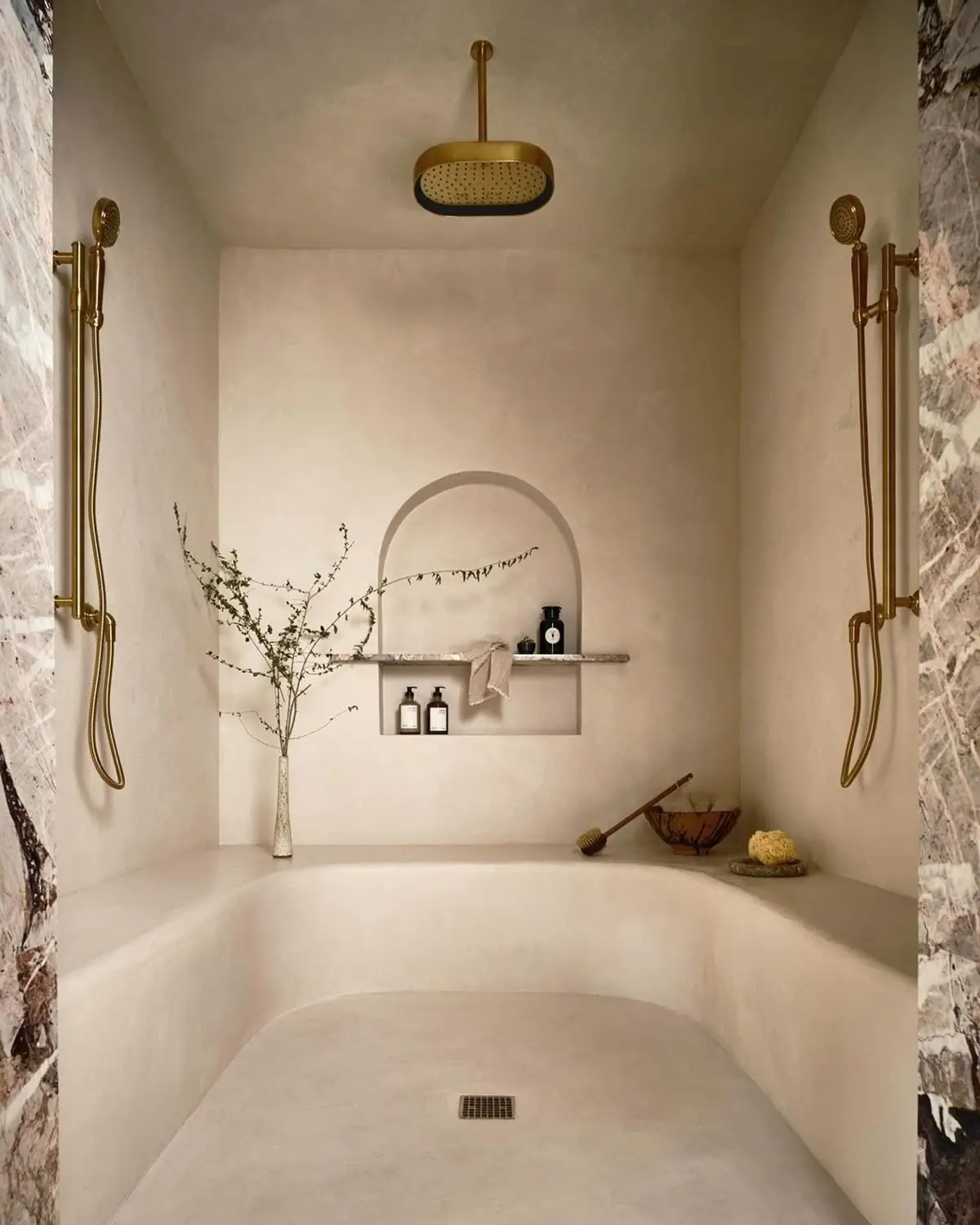
The Moroccan one, and the only genuinely waterproof finish of the three. Lime plaster is troweled on, compressed and burnished with a smooth stone, then treated with olive soap. The soap reacts with the lime to form calcium stearate — a water-repellent layer created within the plaster rather than applied over it.
That chemistry is why tadelakt has lined hammams for centuries and why it is the right material for a shower with no tile and no grout lines in it. The surface runs seamlessly from wall to floor to bench to niche, because there are no joints in it anywhere.
It is the most labour of the three by a distance, and the most rewarding surface to stand in.
- Best for
- Showers, wet rooms, tubs, sinks, hammams, splashbacks
- Not for
- Large dry areas — you would be paying for waterproofing you cannot use
- Durability
- Waterproof, hard, and it takes daily use
- Cost
- The highest of the three — it is days of hand work
- DIY
- No
How to actually decide
Does water hit it directly and often?
Then it is tadelakt, and the other two are not candidates. Shower walls, a tub surround, a wet room floor, the wall behind a sink that gets splashed every day.
Is it a whole house, or outside?
Then it is limewash. It is the only one of the three that makes sense over that much area, the only one that belongs on brick and exterior masonry, and the only one you could do yourself.
Is it one wall you want people to notice?
Then it is Venetian plaster. Depth, sheen and a surface that reads as material rather than colour. This is the finish that makes an entry or a fireplace wall the thing somebody comments on.
Is the existing wall in poor condition?
That pushes you towards plaster. Limewash is translucent and reveals what is underneath rather than hiding it — a patched, uneven or heavily textured wall needs a skim coat before limewash is worth doing. Venetian plaster covers, because it becomes the surface.
Still torn?
Most of our projects use more than one. Limewash through the living areas, Venetian plaster on the entry or the fireplace, tadelakt in the primary bath. They share a material and a palette, so they sit together in a house in a way three different paints never do.
What all three have in common
The reason to be in this family of materials at all, whichever one you land on.
No VOCs, ever. Lime hardens by reacting with carbon dioxide in the air, not by a solvent evaporating out of a film. There is no solvent in it, so there is nothing to off-gas — not on the first day and not in the fifth year. Conventional paint continues releasing VOCs into a room long after it has dried, and the EPA puts it plainly: concentrations of many VOCs are “consistently higher indoors — up to ten times higher — than outdoors”.
Breathable. Vapour passes through all three, so walls dry out rather than trapping moisture behind a film.
Naturally alkaline. High pH is hostile to mould. It is why dairies, cellars and hammams have been lime-finished for centuries.
They get harder with age. Carbonation continues for years. A lime wall five years old is tougher than the same wall five weeks old, which is the exact opposite of a paint film.
Frequently asked
What is the difference between limewash and Venetian plaster?
Thickness and tool. Limewash is slaked lime thinned with water and brushed on in coats you can almost see through — the wall underneath reads through it and the surface stays matte and chalky. Venetian plaster is a lime plaster with marble dust in it, troweled on in multiple thin layers and burnished, which builds a hard surface with depth and a polish that can run from a soft sheen to something close to marble. Same material family, completely different result and completely different labour.
Is Venetian plaster more expensive than limewash?
Considerably, and the gap is labour rather than material. Limewash is brushed on in two coats and a room can be done in a day. Venetian plaster is troweled in multiple passes with drying time between them and burnished by hand at the end, which is skilled work that cannot be rushed. As a rough guide, expect Venetian plaster to run several times the installed cost of limewash on the same wall.
Which is more durable, limewash or Venetian plaster?
Venetian plaster, clearly. It is a thicker, burnished, much harder surface — you can lean on it, wipe it, and put it in a hallway that takes traffic. Limewash is a thin mineral finish and it marks more easily, though it touches up invisibly in a way plaster does not. For a wet area neither is the answer: that is tadelakt.
Can you put Venetian plaster in a bathroom?
On the walls of a bathroom, yes — Venetian plaster handles humidity well and looks superb in one. In the shower itself, no. Direct, repeated water contact wants tadelakt, which is a lime plaster burnished and then sealed with olive soap, forming a genuinely waterproof surface. It has been used in Moroccan hammams for centuries for exactly that reason.
Is Venetian plaster the same as tadelakt?
No, though both are burnished lime plaster and they look related. The difference is the finishing step. Venetian plaster is polished with a steel trowel to build sheen. Tadelakt is compressed with a smooth stone and then treated with olive soap, which reacts with the lime to form calcium stearate — a water-repellent layer within the plaster rather than a coating over it. That reaction is what makes tadelakt waterproof and Venetian plaster merely water-resistant.
Which lime finish is best for a living room?
It depends entirely on what you want the wall to do. If you want softness, movement and light that shifts through the day, limewash. If you want depth, sheen and a surface that reads as a material rather than a colour, Venetian plaster. A useful tiebreaker: limewash draws the eye across a whole room, Venetian plaster draws it to one wall. Many of our projects use both, in the same house.
Can you apply Venetian plaster yourself?
Honestly, mostly no. Limewash is genuinely a DIY material — brush it on thin, twice, and the technique forgives you. Venetian plaster is a trowel skill built over years: the passes have to be laid at the right thickness in the right window, and the burnish has to happen at exactly the right moment in the cure or the surface either will not take a sheen or burns. It is the one finish where we would rather you called somebody than bought a bucket.
Do all three have zero VOCs?
Yes, and for the same reason. Lime hardens by reacting with carbon dioxide in the air rather than by a solvent evaporating out of a film, so there is no solvent to off-gas — not on day one and not in year five. That is the difference that matters against conventional paint, which continues releasing VOCs into a room long after it has dried.
We apply all three
Dallas and Fort Worth, Austin and Central Texas, and Palm Beach, Florida. Certified by the San Marco Academy in Venice, and every project sampled by hand on your own wall before anything is committed to — which is also the fastest way to settle this decision.
Who we are
Thirty seconds, then stay for the podcast.
I’m Ben Lynch. I started LimeWash Pros after reading what the EPA had published about the air inside ordinary American houses — and realizing the walls were the problem.

Meet LimeWash Pros
Who we are, what lime does that paint cannot, and why the air inside your house is the reason we do this.
The podcast
 11:33
11:33From Setback to Limewash Success: Meet Ben Lynch
Why I walked away from conventional paint, what I found in the research on VOCs, and how that turned into LimeWash Pros.
 12:10
12:10How Modern Paint is Killing You
The VOCs in ordinary latex paint don’t stop off-gassing when the wall dries. What that does to the air in your house.
 9:43
9:43The Carcinogen On Your Walls
Benzene is a known human carcinogen and it is in the paint on every surface of your home. What the research says.