Substrate
Limewash on stucco
Stucco and limewash are the same kind of material. Both are mineral renders, both are porous, both move and breathe at compatible rates. This is not a compromise pairing — it is what lime was for.
It also means something nobody selling acrylic can offer: limewash goes straight onto new stucco, with no primer and no barrier coat, while the alkalinity is still high enough to destroy a paint film.
Two things will stop you, and both are on this page.
Pails — $225 Order samples first

Why lime goes on new stucco and paint does not
Fresh Portland-cement stucco is strongly alkaline while it cures. That alkalinity chemically attacks an acrylic binder — it saponifies the film, which is the technical word for turning it into soap. It is the reason paint manufacturers tell you to wait thirty days, or sell you an alkali-resistant primer to put between their product and your wall.
Lime is the alkaline material. There is nothing for the alkalinity to react against, because high pH is where limewash already lives. Follow your plasterer’s cure schedule for the stucco’s own structural sake, then limewash it directly.
No primer. No barrier coat. No thirty-day wait on the coating’s account.
How many pails a house takes
Work from wall area, not floor area — this is where most people get it wrong by a factor of two. Measure each elevation, length times height, add them together, subtract windows and doors.
One five-gallon pail covers roughly 700 square feet at the two coats an exterior wants.
| House | Wall area | Pails |
|---|---|---|
| Single-storey, roughly 1,200 sq ft house | ~1,200–1,500 sq ft of wall | 2–3 pails |
| Two-storey, roughly 2,000 sq ft house | ~2,000–2,500 sq ft of wall | 3–4 pails |
| Two-storey, roughly 3,000 sq ft house | ~3,000–3,500 sq ft of wall | 5–6 pails |
| Garden or boundary wall, 6 ft × 60 ft, both faces | ~720 sq ft | 1–2 pails |
Rough, honest guides from typical geometry — a house with tall gables or a lot of blank wall runs higher. Measure before you order. Deep colours take an extra coat and an extra pail.
$225 a pail — $45 a gallon, against $50 buying singles. On an exterior, always buy pails.

Why elastomeric fails on stucco and limewash does not
This is the argument worth understanding before you spend money either way.
An elastomeric coating is deliberately vapour-closed. It is sold as waterproofing, and it does seal the face of the wall.
But stucco is a mineral render designed to absorb moisture and release it again. Water gets into a wall from more directions than the front — a roof leak, a failed flashing, rising damp, water vapour pushing out from inside a heated house in winter. Seal the face and that moisture has nowhere to go. It collects behind the coating and eventually pushes it off in sheets, bringing stucco with it.
Limewash is vapour-open. It does not form a film. It keys into the render and lets the wall keep doing what it was built to do, which is breathe.
It also means limewash does not fail the way a film fails. There is no film to blister, peel or flake. It weathers and erodes extremely slowly, and a refresh is one coat straight over the old one with no stripping and no preparation. That is a different maintenance proposition from repainting a house.
The two things that will stop you
An existing acrylic or elastomeric coating
A sound coating has no porosity, so there is nothing for the lime to key into and it will dust or flake once cured. It has to come off, or you need a mineral primer made for lime and silicate systems to re-establish an absorbent surface.
If the existing paint is already peeling, that is less an obstacle than a schedule. It is coming off either way.
Cracks
Limewash has no crack-bridging ability at all. It is a thin mineral wash, not a flexible membrane, and it will not hide a crack or hold one closed.
Repair cracks properly first, with a lime or cement-based patch compatible with the render. A crack you limewash over is a crack you can still see, and it will keep moving.
Both of these cost us sales on this page. We would rather lose the order than have four pails go onto a wall they were never going to stay on.
The method, on stucco specifically
1. Wash, repair, and brush off efflorescence
Clean the wall down and let it dry. Repair cracks and spalls. If there is white powdery efflorescence — salts that have migrated out of the masonry — brush it off dry. Washing it only dissolves the salts and carries them back into the wall to come out again later.
2. Follow the shade
This is the step that decides an exterior. Stucco is thirsty, and in direct sun it pulls the water out of the wash in seconds — leaving a chalky coat that never properly bonded.
Work on the shaded elevation and follow the shade around the house through the day. Do not limewash a sunlit south wall at noon. Early morning, late afternoon, or an overcast day.
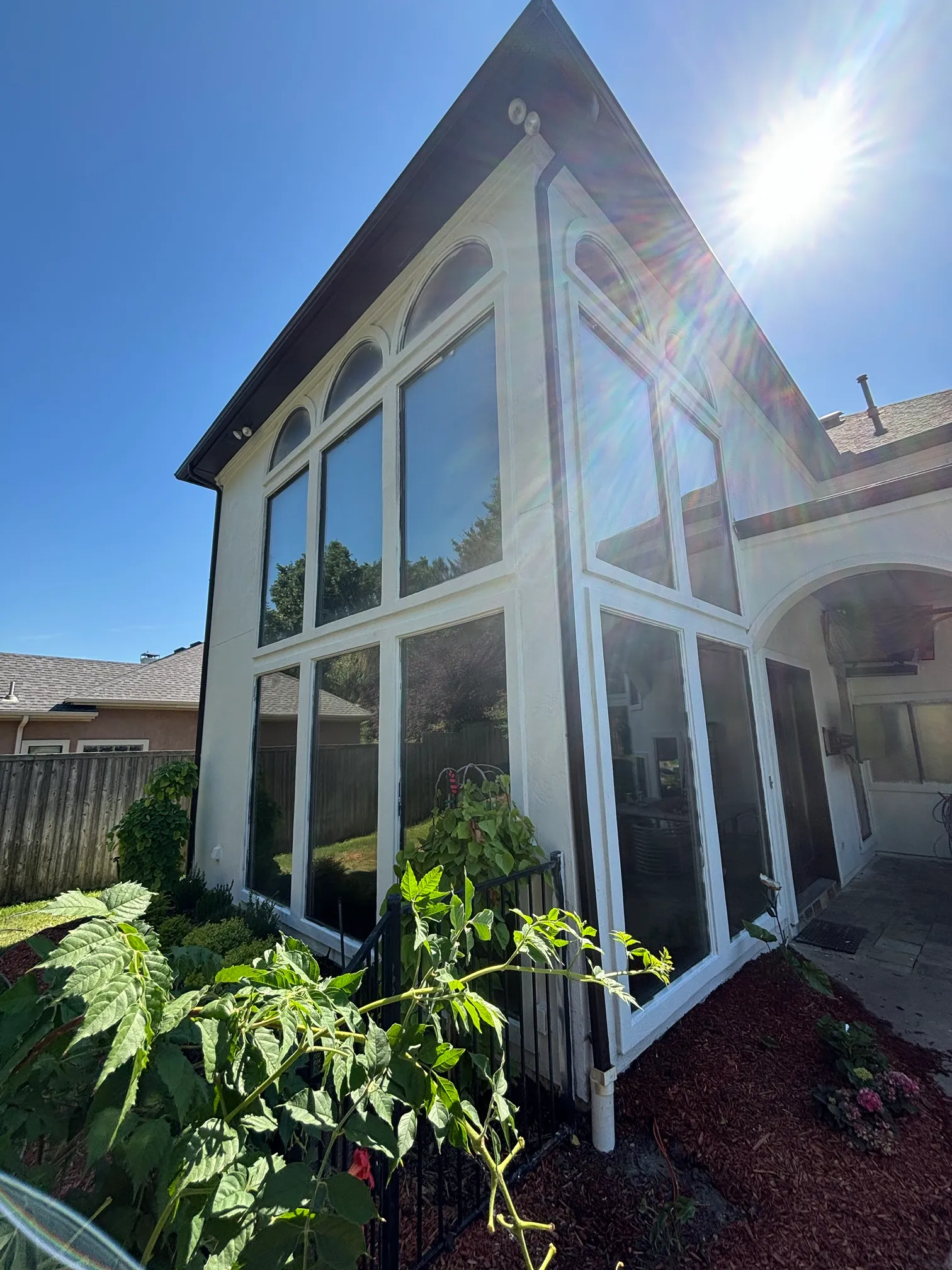
3. Dampen each section before you brush it
Mist with clean water until the stucco is damp but not running, and do it section by section just ahead of yourself rather than wetting the whole wall at once. Damp render draws the lime in evenly.
4. Two coats, thinned first, cross-hatched
First coat thinned and worked in with a masonry or block brush in a cross-hatch motion. It will look thin and patchy; that is correct. Second coat at full consistency once the first has set up.
On new stucco, and on any deep colour, plan for a third coat to even it out. Budget the extra pail now rather than discovering it on the last elevation.
5. Keep an elevation wet-on-wet
Finish a whole elevation in one session where you can. Stopping halfway across a blank wall and resuming the next day can leave a visible line, because the two halves carbonate on different schedules. Break at corners, downpipes and window reveals instead.
6. Do not seal it
Sealing stucco limewash reintroduces the exact trapped-moisture problem you avoided by choosing lime, blocks the carbonation still hardening the finish, and flattens the depth. Leave it.
Colour on a big wall
Limewash is translucent, so a deep shade needs more coats to reach depth and shows brush movement far more plainly than a pale one. Done well that is the whole point. Done badly, on two thousand square feet, it is very visible.
Slate, Charcoal and Terracotta are genuinely beautiful on stucco. Order the samples and stick them on the actual elevation, in the actual light, before you commit to four pails — and look at them at midday and at dusk, because a south wall in Texas does something quite different at each.

Or have it done
A full stucco exterior is a real job, mostly because of the shade discipline and the scaffolding. If the house is in Dallas–Fort Worth, Central Texas or Palm Beach, this is what we do, and every project is sampled personally by Ben Lynch, certified by the San Marco Academy in Venice.
If you run your own crew and want the material rather than the labour, we price trade and wholesale properly.
Common questions
Can you limewash stucco?
Stucco is one of the best surfaces for limewash there is. Traditional and cement stucco are both porous mineral renders, which is exactly what lime needs to key into, and the two materials move and breathe at compatible rates. The only genuine disqualifiers are an existing elastomeric or acrylic coating, and unrepaired cracking.
How much limewash do I need for a stucco house?
Work from wall area, not floor area. One five-gallon pail covers roughly 700 square feet at the two coats an exterior wants. A two-storey house of about 2,000 square feet is commonly 2,000 to 2,500 square feet of wall, which is three to four pails. A single-storey 1,200 square foot house is usually two to three. Measure each elevation — length times height — add them up, and subtract the windows and doors.
Can you limewash new stucco?
Yes, and this is where lime has a real advantage over paint. Fresh Portland-cement stucco is strongly alkaline as it cures, and that alkalinity attacks an acrylic film — which is why paint manufacturers tell you to wait 30 days or sell you an alkali-resistant primer. Lime is itself the alkaline material, so there is nothing to react against. Follow your plasterer’s cure schedule for the stucco’s own sake, then limewash it directly. No primer, no barrier coat.
Can you limewash over painted stucco?
Not over a sound acrylic or elastomeric coating. Those are sealed films with no porosity, so limewash has nothing to key into and will dust or flake once cured. The coating has to come off, or you need a mineral primer made for lime and silicate systems to re-establish an absorbent surface. If the existing paint is already peeling, that is not an obstacle so much as a schedule — it is coming off either way.
Will limewash cover cracks in stucco?
No. Limewash is a thin mineral wash, not an elastomeric coating, and it has no crack-bridging ability whatsoever. Repair cracks properly with a compatible lime or cement-based patch before you start. A crack you limewash over is a crack you can still see, and it will keep moving.
Is limewash better than elastomeric paint on stucco?
For the long-term health of the wall, we think so, and this is the argument worth understanding. Elastomeric coatings are deliberately vapour-closed — they seal the face of the wall. Stucco is a mineral render designed to absorb moisture and release it. Seal the face and moisture that gets in from behind, through a leak or rising damp or vapour from inside the house, cannot get out. It collects behind the coating and pushes it off in sheets, taking stucco with it. Limewash is vapour-open and lets the wall keep doing what it was built to do.
How long does limewash last on stucco?
It does not fail the way a film does, because there is no film to fail. Limewash erodes extremely slowly and weathers rather than peeling, blistering or flaking, and it keeps hardening for years as it carbonates. Expect to refresh an exposed elevation long before you would ever strip it, and a refresh is a single coat straight over the old one with no preparation — which is a materially different maintenance proposition from repainting.
Do I need to dampen stucco before limewashing?
Yes, and on stucco it matters more than on any other surface. Stucco is thirsty, and in direct sun it will pull the water out of the wash in seconds, leaving a chalky coat that never bonded properly. Mist each section with clean water until it is damp but not running, work in the shade, and follow the shade around the house through the day. Do not limewash a sunlit south elevation at noon.
Can you limewash stucco a dark colour?
You can, and think about it first. Limewash is translucent, so deep shades take more coats to reach depth and show brush movement far more plainly than pale ones — which is lovely done well and obvious done badly. On a large exterior that is a lot of square feet of visible technique. Slate and Charcoal are beautiful on stucco; order samples and put them on the actual wall before committing to four pails.
Do I need to seal limewash on stucco?
No. Sealing it is the one thing most likely to ruin it. A topcoat makes the wall vapour-closed again, which reintroduces the exact trapped-moisture problem you avoided by choosing lime, blocks the carbonation that is still hardening the finish, and flattens the depth. Leave it alone.
Ready to order
Measure the elevations, repair the cracks, follow the shade. $225 a five-gallon pail — $45 a gallon — covering about 700 square feet at two coats, tinted by hand and shipped anywhere in the United States, with the full application course included.
Who we are
Thirty seconds, then stay for the podcast.
I’m Ben Lynch. I started LimeWash Pros after reading what the EPA had published about the air inside ordinary American houses — and realizing the walls were the problem.

Meet LimeWash Pros
Who we are, what lime does that paint cannot, and why the air inside your house is the reason we do this.
The podcast
 11:33
From Setback to Limewash Success: Meet Ben Lynch
Why I walked away from conventional paint, what I found in the research on VOCs, and how that turned into LimeWash Pros.
 12:10
How Modern Paint is Killing You
The VOCs in ordinary latex paint don’t stop off-gassing when the wall dries. What that does to the air in your house.
 9:43
The Carcinogen On Your Walls
Benzene is a known human carcinogen and it is in the paint on every surface of your home. What the research says.